Search engine optimization is a key characteristic of any successful business’s website, yet it is one of the most challenging things to do, especially with AI slowly taking over search.
What if there were an AI solution that could audit your website for areas to improve to rank higher on Google, ChatGPT, and any search engine?
Typically, people would have to search through countless YouTube videos, social media posts, and articles to find the common issues, and still not see improvements.
No online resource is personalized for the website owner, and typically not specific enough to allow for any changes.
That’s why agencies are building AI SEO Auditors, so I did the same.
This flow directly reads the info on your website, the headings, meta descriptions, and keywords to find areas for improvement.
The Workflow
It begins with a simple form, where I type in the website I want to optimize. All I need to do is wait a little less than a minute, and an email will pop up in my inbox with a thorough report.
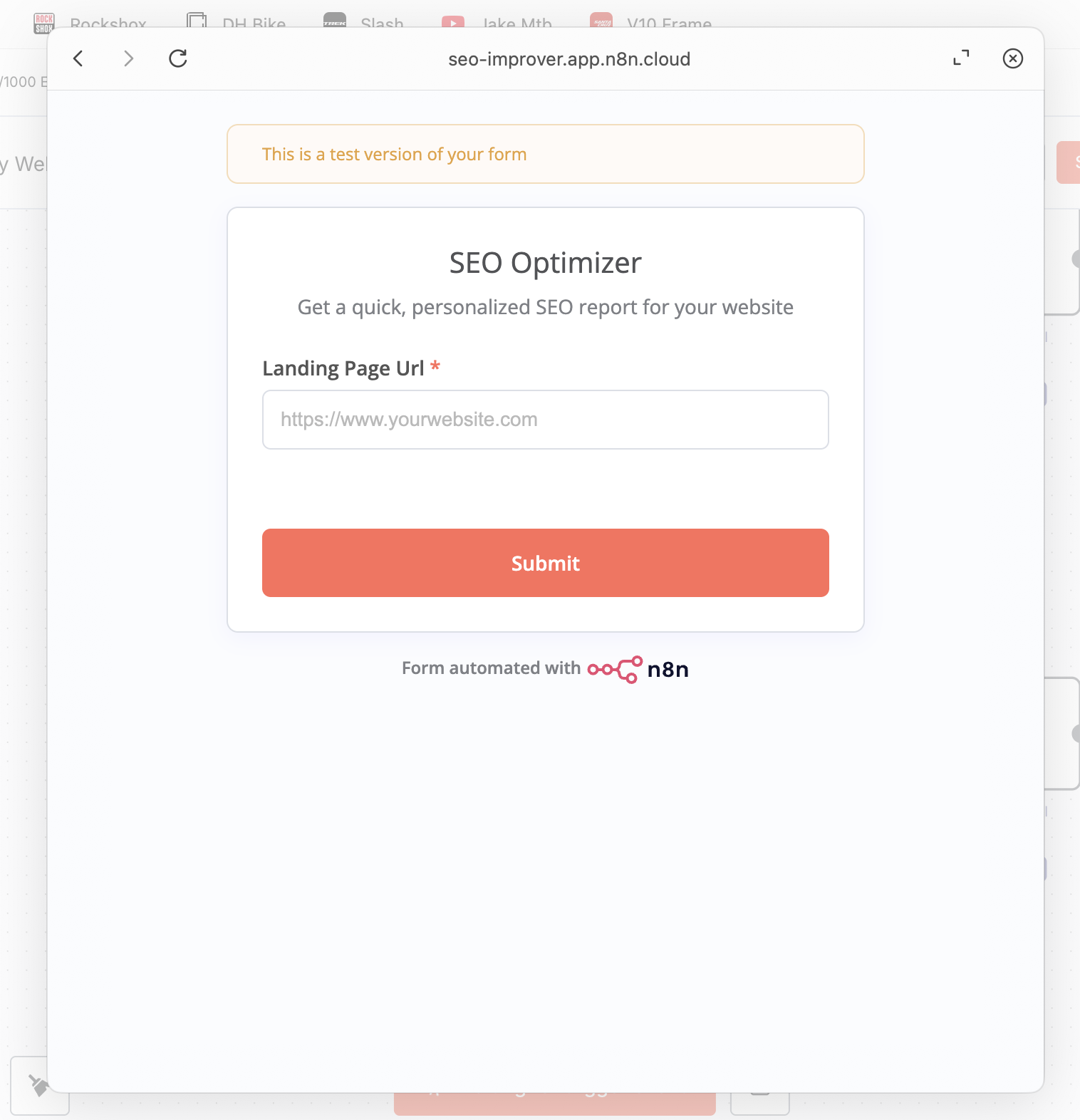
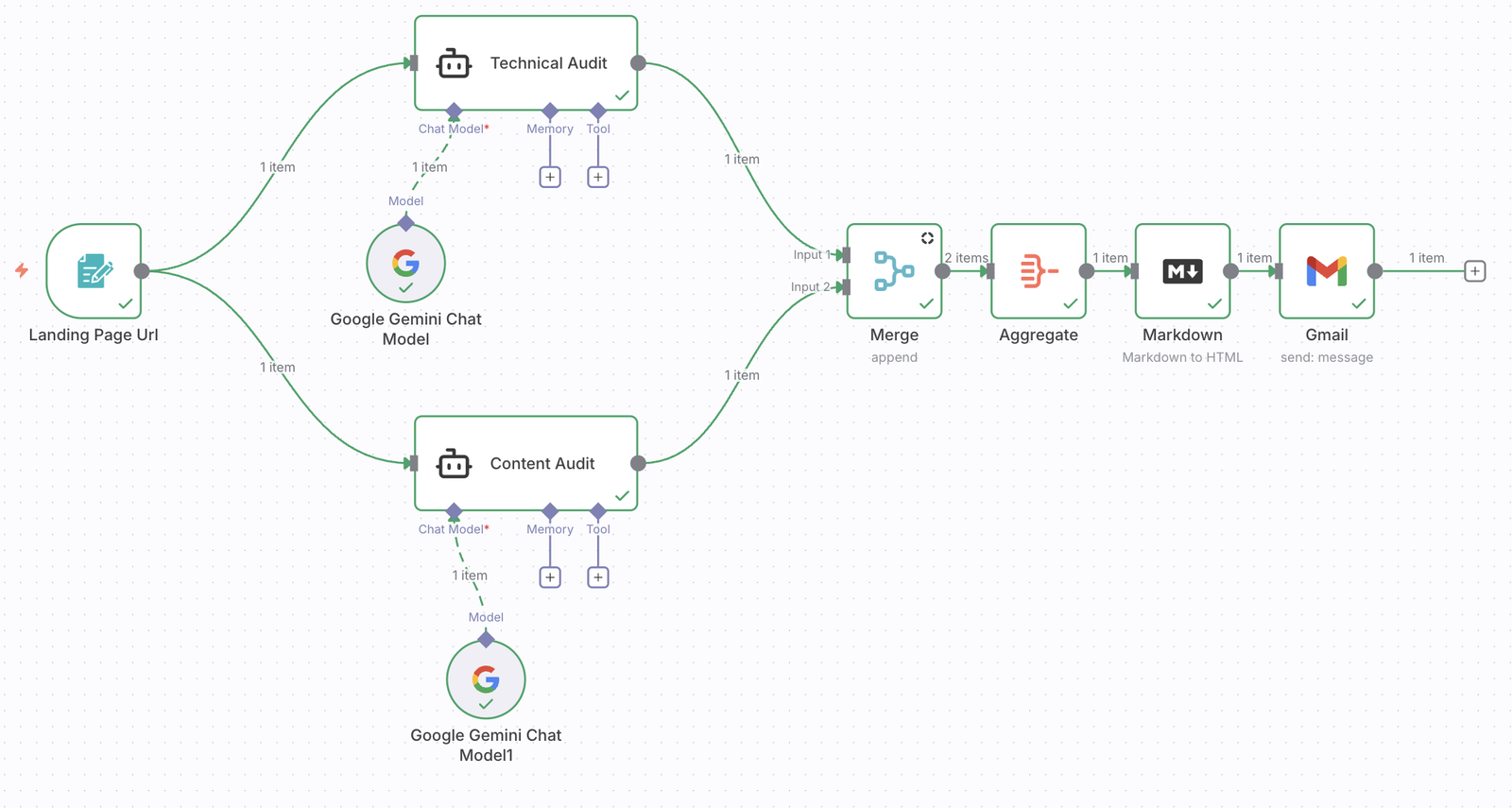
As simple as it seems, it is more complex on the backend. After the URL is entered and submitted, it is sent to two AI agent nodes.
Each one connected to an LLM, using Google Gemini, I was able to get free API keys to use their model.
Google offers limited free token usage for certain Gemini models, so I took advantage of that to build this project without spending money.
Both nodes, while connected to the same LLM, have different prompts. One uses a technical audit prompt, which analyzes the webpage meta descriptions, headers, and other keywords.
The other uses a content audit prompt, which analyzes blog posts, images, and all things related, like every image’s alt text.
By using role prompting, the Workflow is able to get strong results from the LLM. The template I followed uses the phrase, “You are a top-tier SEO Manager with deep expertise in technical SEO,” to ensure the AI understands the job fully and knows to only focus on gathering info from its databases that align with that role.
The results are then merged and sent via email to the address input. This email is valuable as it allows users to set a schedule trigger that is recurring, to get weekly, monthly, etc., interval-based SEO reports to ensure the website is consistently being optimized.
Through this project, I firsthand saw the power of combining AI with a variety of unlimited tools. I have so many ideas of where I can take this further, and I feel it stimulated my brain in a way that I also get to improve my business.
This project was the second step of my TKS focus process, before I wrote about how the Shopify Sidekick E-Commerce agent is built, and next I plan to incorporate some sort of automation or Workflow with that AI to do CRO.
I highly recommend the guides from Bilal Naseer of WebSensePro, as that is what taught me.
Thank you for reading, and please connect to my LinkedIn if you would like to chat about AI, e-commerce, or something else cool!